There is a new scam that is happening…the caller ID says St. Mary of Sorrows with our phone number, but it is not us. They ask about Walmart charges and want to give you a credit if you give them your bank information. DO NOT engage, just hang up.
The sign up for the 40 Hours of Devotion is in the narthex this weekend and starts after the Sunday 5:00pm Mass this weekend and continues until 9:00am on Tuesday.

 Join us for the Feast Day Celebration this Saturday for Spaghetti Dinner after the 5:00pm Mass, Pancake Breakfast on Sunday after the 7:30 and 9:30am Masses and a Reception after the 9:15am Mass on Tuesday in Farrell Hall.
The Olivewood Group will be at the church the weekend of September 19-20 with carvings and olive oil from the Holy Land. Please support them.
The Women’s Group is holding a “Meet and Greet” meeting on Sunday, September 20th from 3:00pm to 5:00pm in St. Joseph’s Hall.
Starting on September 18th, there will be a Sacred Heart of Jesus Holy Hour starting at 7:00pm in the church. Every third Friday Holy Hour will be devoted to the Sacred Heart of Jesus. See the bulletin for more information.
That Man Is You! – Apostles of the New Springtime starts Saturday, September 19 in Saint Joseph Hall. SATURDAY MORNINGS 7:15 am to 8:30 am. See the bulletin for details.
 The 2026–2027 Religious Education
 year is starting this weekend.
SAVE THE DATE: The following events are coming up. Please make note on your calendar and watch for further information in our bulletin, on our website or in future Flocknotes!!
Scheduled Monthly Events:
All-day Adoration is in the Parish Center Chapel from 7:00am until 7:00pm and on First Friday, all-night Adoration from 7:00pm is available in the church every First Friday with Saturday devotions on the First Saturdays of the month. All Day and Night Adoration will be offered for Sunday and Monday for the 40 Hours of Devotion leading up to our Feast Day on Tuesday. Sign up fo Adoration at https://smos.weadorehim.com.
Young Adults gather for coffee and breakfast the first Sunday of the month after the 9:30am Mass every month.
- Luminaries of Holy Mary will meet on the first Monday of the month in the Conference Room from 5:00pm to 6:30pm to discuss Fatima and pray the Rosary. There is a meeting on Monday, September 14th in the Conference Room at 5:00pm.
- Diapers, Wipes and Formula will be collected during the weekend of the fourth Sunday of the month and donations can be left in the foyer of the Parish Center. Collection is next weekend.
- The second collection on the third Sunday of the month is for debt reduction. Collection is next weekend.
- Food Pantry donation bags are usually given out the first weekend of the month with the collection through the second Sunday at 1:00pm. Collection is this weekend until 1:00pm on Sunday.
- Martha’s Table4th Sunday Sandwich Collection will be on the fourth Sunday, only from 1-3 PM.Drop off at the back of Farrell Hall (Door 4). Full details at tinyurl.com/MTSandwiches. The collection is next weekend.
Upcoming Events:
St. Mary’s will be offering a Grief Support Group starting on Wednesday, September 16th from 10:00am to 11:30am weekly for twelve weeks. For more information contact Kathy Maurer at griefcare4uu@gmail.com or call703-425-0003. Registration is required.
Ladies, does your prayer life need some help and encouragement?
Come join, Women Growing in Prayer. Rooted in Ignatian Spirituality, we read, pray, and journal daily and then meet every Tuesday evening in-person offsite to share our faith life (7:00 pm to 8:30 pm). Starting this Fall (Sept 15), we will begin with the book, “The Fulfillment of All Desire,” by Ralph Martin. All are welcome, wherever you are in your faith journey. God Bless
Join Deacon Nick for an upcoming series of talks entitled “Coffee, Creed and Catechism” on Monday mornings after 9:15am Mass in St. Joseph’s Hall. The 16-week series starts on September 14th.
“Life Everlasting: Heaven, Hell, Death and Judgment” our next Thursday evening Group Study (5 sessions via GoogleMeet). Presented by Drs. Edward Sri & Jeffrey Morrow; study guide for $15.99 and online access for $6.95 from Ascension Press. Starts September 17, 2026. For more info or sign up:b.mahiq@verizon.net
Calling all 5th-12th graders who love acting! Join the Mystery Theater Production every Tuesday from 4:00pm to 5:00pm. Email Jonathan at jonathanr@stmaryofsorrows.org. The production will be performed in early May.
A Man for All SeasonsThe story of our diocesan patron, St Thomas More, is told in this award-winning film (6 Oscars, including Best Picture). The messages of the film, including St Thomas More’s refusal to violate his religious beliefs, and that a person’s soul is his most precious possession, not worldly gains and power, are as applicable now as they were then. September 26 in St Joseph’s Hall. A delicious meal will be served at 6, with the film beginning at 6:30.
Women’s Bible Study and Fellowship: Are you a woman who wants to carve time out to intentionally read the Bible, grow in your relationship with God, and form meaningful friendships in the parish? Consider joining the upcoming Thursday morning or evening sessions of Walking with Purpose Bible Study for 2nd (Letter of St. Paul to) Timothy beginning October 1st. We will have sessions at the Parish Center most Thursdays from October 1, 2026- March 11, 2027. For more information, contact Mary Alice at matdrag38@earthlink.net (morning session) or Katie at mastersonka@gmail.com (evening session). All are invited to an early morning Mass at 5:30 am the first Monday of each month starting October 5. We are trying to provide, monthly, a daily Mass opportunity for all those whose work schedule does not permit them to attend our normal daily Mass scheduled at 6:30 am and 9:15 am and for all early risers who are ready to get their day started.
Try food from 30 countries and experience the culture at International Night on Saturday, October 17th starting at 6:30pm in St. Joseph’s Hall.
Movie Night 6:00pm on Saturday, October 24th. A compilation of all of the Last Supper scenes from each of the episodes from season 5, but in chronological order. A good way to prepare for next month’s release of Season 6, which takes us from the Garden to the Cross.



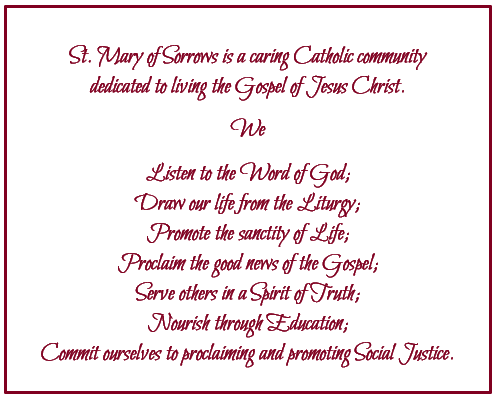
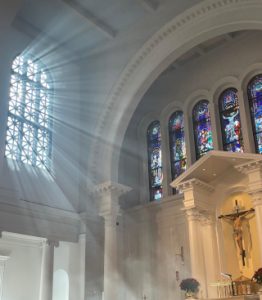 On behalf of our parish family, welcome to St. Mary of Sorrows parish website! We would love for you to join us on Sunday, and every day! Please look over our website and if we can be of help to you, please do not hesitate to contact me or a staff member. Our mission/vision statement is listed below to provide you with a deeper sense of our commitment to our Lord Jesus.